
Stop obsessing over citations and fix these three proximity signals instead
Stop Obsessing Over Citations and Fix These Three Proximity Signals Instead
If you are a plumber in Gilbert, a roofer in Mesa, or an SEO professional managing local accounts, you’ve likely felt the frustration of the “ranking plateau.” You’ve built 100+ citations on Yelp, YellowPages, and niche directories. Your NAP (Name, Address, Phone) is perfectly consistent. Your Google Business Profile is fully optimized. Yet, you’re stuck at position #4 or #5 – just outside the coveted Map Pack – while a competitor with half your reviews and a messy citation profile sits at #1.
The reason? You are playing by 2018 rules in a 2026 world. In the current local search landscape, citations have become “table stakes.” They are necessary to prove you are a legitimate business, but they no longer provide the competitive edge needed to dominate your service area. As we move through 2026, Google has shifted its weight toward Proximity Signals that determine your “ranking radius.”
Section 1: The Citation Myth and the 2026 Reality
For years, the local SEO industry has obsessed over citation volume. The logic was simple: more mentions of your business across the web equaled more trust. While it is true that consistent NAP information makes a business 40% more likely to appear in the Local Pack, the incremental value of the 101st citation is virtually zero.
Google’s algorithm has evolved to prioritize user experience and real-world relevance over directory counts. Consider this: “near me” searches have exploded by 136% in recent years. This surge forced Google to tighten the “Proximity” filter. It’s no longer enough to be *in* a city; you have to prove your relevance to the specific micro-location of the searcher.
Furthermore, the weight of traditional signals is shifting. Reviews now account for 20% of ranking importance (up from 16% just a few years ago), but even reviews are being filtered through the lens of proximity. If you want to break through the noise, you need to understand that proximity isn’t just a distance measurement – it’s a signal you can optimize. To understand how these shifts impact your specific market, read more about Arizona SEO: Why Proximity Signals Now Outweigh Reviews in 2026.
Section 2: Understanding the “Proximity Trap”
Have you ever checked your rankings while sitting in your office and seen your business at #1, only to drive two miles down the road and find yourself invisible? This is the Proximity Trap.
Google’s local algorithm is built on three pillars: Proximity, Relevance, and Prominence.
- Proximity: How close is the business to the searcher?
- Relevance: How well does the business match the search query?
- Prominence: How well-known is the business (links, reviews, brand mentions)?
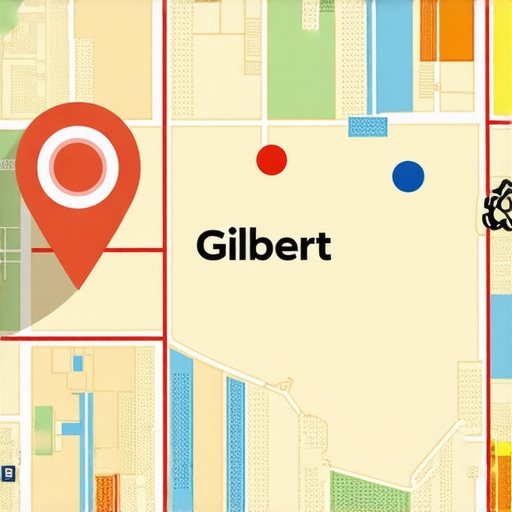
The Proximity Trap occurs when Google’s “Proximity Bias” overrides your Relevance and Prominence. Google would rather show a mediocre locksmith 500 feet away than a world-class locksmith 3 miles away. This creates a “ranking bubble” that limits your leads to a tiny radius around your physical address. To dominate a city like Gilbert or Mesa, you have to “stretch” your proximity signal so Google trusts your relevance even when the searcher is across town. This is a common hurdle for many; learn more about The Proximity Trap: Why Your Shop Is Invisible to Gilbert Customers Two Miles Away.
Section 3: Signal #1 – Entity-Based Geo-Anchoring
To expand your radius, you must stop thinking about keywords and start thinking about Entities. Google no longer just reads text; it maps relationships between real-world objects, locations, and businesses. If Google views your business as a “Gilbert Plumber” entity, you will rank. If it just sees you as a website with the word “plumber” on it, you won’t.
The most effective way to anchor your entity to a specific geography is through advanced Local Business Schema. You need to move beyond basic schema and include specific latitude and longitude coordinates, as well as `geo-shape` data that defines your service area. This tells Google exactly where your physical “anchor” is located. For a deep dive into the technical implementation, check out The specific schema script that anchors your shop to Gilbert search results.
Beyond code, you need Hyperlocal Content. Most businesses write generic blog posts like “How to fix a leaky pipe.” A proximity-optimized business writes “How the hard water in the Val Vista Lakes neighborhood of Gilbert affects your copper piping.” By mentioning specific neighborhoods, landmarks, and local intersections, you are feeding Google’s Knowledge Graph the data it needs to associate your business with those specific sub-locales. This is a core component of modern google business profile seo.
When you anchor your entity to specific neighborhoods, you are effectively telling Google, “I am not just in Gilbert; I am an authority in Power Ranch, Agritopia, and Morrison Ranch.” This semantic relevance helps you bypass the Proximity Trap by proving you are the most *relevant* result, even if you aren’t the *closest* one.
Section 4: Signal #2 – Review Semantics & Geo-Tagged Engagement
We know reviews are important, but in 2026, the *content* of the review matters more than the star rating. Google uses Natural Language Processing (NLP) to extract “justifications” – those little snippets in the Map Pack that say “Their website mentions…” or “A reviewer said…”
To fix your proximity signals, you need Review Semantics. You should actively encourage customers to mention two things in their reviews:
- The specific service they received (e.g., “water heater installation”).
- The specific neighborhood or landmark near them (e.g., “near the Gilbert Heritage District”).
When a customer writes, “Best HVAC repair near SanTan Village,” they are providing Google with a third-party verification of your proximity to that landmark. This is significantly more powerful than you simply claiming to serve that area on your website.
Furthermore, your responses to reviews are a missed opportunity for proximity anchoring. Instead of saying “Thanks for the review!”, try “It was a pleasure helping you with your AC repair near the Freestone Park area! We love serving our neighbors in East Gilbert.” This reinforces the geo-entity relationship. However, be careful with your engagement strategy; Why ignoring negative Gilbert reviews is actually tanking your map pack position is a must-read for any business owner trying to maintain their reputation and ranking.
Google also tracks user engagement signals. If searchers in a specific part of town consistently click on your listing and request directions, Google will expand your ranking radius in that direction. This is why “geo-tagged engagement” – real people interacting with your profile from different locations – is a critical factor in how you rank google business profile listings effectively.
Section 5: Signal #3 – Technical Proximity Anchoring (Map Embeds & Site Speed)
The technical structure of your website can either amplify or muffled your proximity signals. A common mistake is the “Lazy Map Embed.” Many SEOs simply grab an iframe from Google Maps and drop it in the footer of every page. While this shows where you are, it often creates a massive “DOM size” issue and slows down your site.
Site speed is a confirmed ranking factor, and for local search, mobile speed is king. If your site takes 5 seconds to load because of a heavy map script, your Map Pack rankings will suffer. You need to use “Lazy Loading” for your maps or, better yet, use a static image of your map that links to your Google Business Profile. For more on this technical pitfall, see Why standard map embed strategies are actually slowing down your site load.
To truly master technical proximity, you need to use local seo tools that allow you to monitor your “Grid Rank.” A standard rank tracker tells you that you are #1 in “Gilbert.” A grid tracker shows you that you are #1 at your office, #3 two blocks away, and #10 five blocks away. This granular data allows you to see exactly where your proximity signal is failing.
If you see a “dead zone” in your ranking grid, that is where you need to point your hyperlocal content and review generation efforts. Using a professional google maps ranking service can help you identify these gaps and implement the technical fixes – like optimized KML files and geo-sitemaps – that citations alone can never address.
Section 6: The 2026 Update: Video Verification & Trust
As we move further into 2026, Google is doubling down on “Real World” verification to fight the plague of “ghost offices” and lead-gen spam. The most significant change is the mandatory Video Verification audit. Google is no longer satisfied with a postcard; they want a live or recorded video walkthrough of your physical location, your branded vehicle, and your tools of the trade.
This is a proximity signal in its purest form. Google is using AI to analyze these videos to ensure the physical environment matches the claimed location. If you are a service-area business (SAB), they want to see your equipment and your home base. Failing this audit doesn’t just mean a suspended profile; it means your business entity is flagged as “low trust,” making it nearly impossible to rank outside of a 1-mile radius.
Preparation is key. You need to ensure your physical signage, vehicle wraps, and even your business license are ready for the camera. To ensure you don’t get caught off guard, follow our guide on how to Pass the 2026 Google Maps Gilbert Video Audit First Try. This level of verification is becoming the ultimate “Prominence” signal, separating legitimate local authorities from the “citation-only” pretenders.
Conclusion: Stop Building, Start Anchoring
The era of winning Local SEO through sheer volume of citations is over. In 2026, the winners are those who understand the nuance of proximity. By focusing on Entity-Based Geo-Anchoring, Review Semantics, and Technical Proximity Anchoring, you can break out of the “Proximity Trap” and capture leads from across your entire city.
Don’t let your business be a “parking lot hero” that only ranks when customers are standing at your front door. Audit your proximity signals today. Use a google maps rank tracker to visualize your current reach, and start implementing the hyperlocal strategies that actually move the needle. If you’re ready to take your visibility to the next level, it’s time to invest in a professional google maps ranking service that understands the 2026 algorithm. Stop obsessing over the 136th directory listing and start fixing the signals that actually matter.
About Hasnain Ahmad: I am a Local SEO Expert and Google Business Profile Specialist with over 5 years of hands-on experience helping businesses strengthen their online presence. My focus is on technical local signals and entity building that drive real-world revenue, not just vanity metrics.